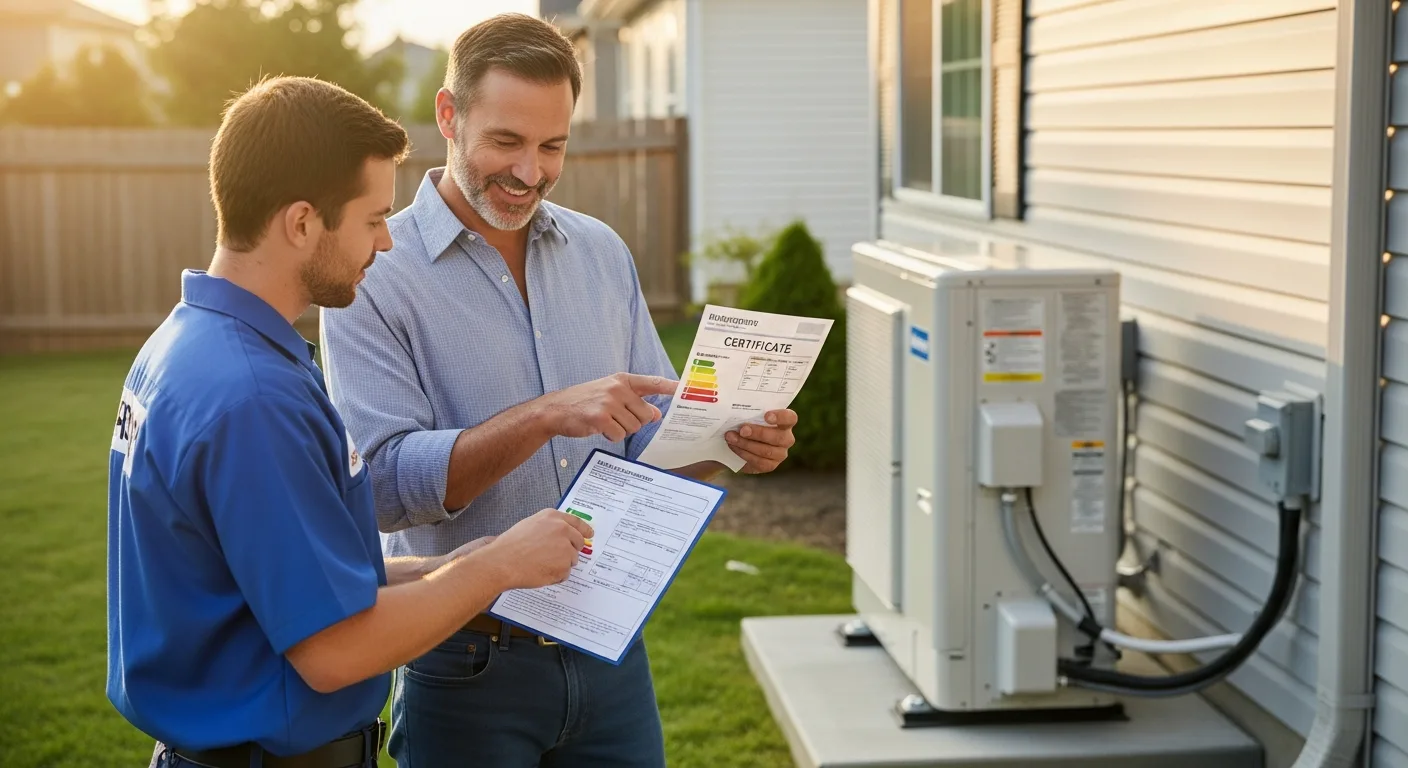
The Inflation Reduction Act expanded the IRS Section 25C Energy Efficient Home Improvement Credit in 2023. It now gives homeowners 30% back on qualifying HVAC equipment, with annual caps of up to $3,200 combined. The credit runs through 2032.
Quick Answer
Section 25C gives homeowners 30% back on qualifying HVAC equipment: up to $600/year for a qualifying central AC or furnace, up to $2,000/year for a qualifying heat pump. HVAC contractors who explain this clearly on their website and in their proposals close more jobs at higher ticket values.
Key Takeaways:
- Section 25C covers 30% of cost, capped at $600 for AC/furnace or $2,000 for heat pumps, per tax year
- The annual overall cap for all 25C improvements is $3,200 per household
- Credits reset each year from 2023 through 2032, so homeowners can claim in multiple years
- Equipment must be ENERGY STAR Most Efficient or meet specific AFUE/SEER2/HSPF2 thresholds
- Only the equipment cost qualifies, not labor
- New construction does not qualify. Existing primary residences only
- HVAC contractors who educate customers on this win more installs by reducing sticker shock
Ranking for tax credit searches means more installs
Homeowners are actively searching "hvac tax credit 2025" and "section 25c heat pump" before they call. If you rank, you get the call.
What Is the Section 25C Credit?
Section 25C of the Internal Revenue Code has existed in some form since 2006, but the Inflation Reduction Act (IRA), signed into law in August 2022 and effective from 1 January 2023, dramatically expanded it. The credit now applies to a broader range of equipment at higher amounts, and it runs annually through 2032.
Its official name is the Energy Efficient Home Improvement Credit. It is a non-refundable federal tax credit that reduces what a homeowner owes in federal income tax for the year in which qualifying equipment was installed.
The credit is capped per category per year, but crucially, the caps reset every tax year. A homeowner who installs a qualifying heat pump in 2025 and a qualifying furnace in 2026 can claim credits in both years.
Credit Amounts by Equipment Type
Here's what qualifies and what homeowners can claim:
| Equipment Type | Minimum Efficiency | Annual Credit Cap |
|---|---|---|
| Central Air Conditioner | ENERGY STAR Most Efficient (25 SEER2+) | $600 |
| Gas/Propane Furnace | 97% AFUE or higher | $600 |
| Oil Furnace | 95% AFUE or higher | $600 |
| Air-Source Heat Pump | ENERGY STAR Most Efficient (16 HSPF2+) | $2,000 |
| Heat Pump Water Heater | ENERGY STAR Most Efficient (UEF 2.2+) | $2,000 (combined with heat pump) |
*The $2,000 cap applies across heat pumps and heat pump water heaters combined. Overall 25C cap is $3,200 per year across all qualifying improvements. Verify current efficiency thresholds with the manufacturer or at energystar.gov.
The credit is 30% of the equipment cost, not 30% of the total invoice. Labor, installation fees, and disposal costs do not count toward the credit calculation. The homeowner claims the credit based on the purchase price of the qualifying unit itself.
What Does "ENERGY STAR Most Efficient" Mean?
ENERGY STAR Most Efficient is a distinct tier above standard ENERGY STAR certification. Not all ENERGY STAR products qualify for the 25C credit. Only those that also meet the "Most Efficient" criteria or the specific AFUE/SEER2/HSPF2 thresholds set by the IRS.
The easiest way to confirm whether a specific model qualifies is to check the ENERGY STAR Certified Products list at energystar.gov. The list is searchable by product type and model number. Manufacturers also publish Manufacturer's Certification Statements for qualifying models, which is the document homeowners need to attach when claiming the credit.
As a contractor, you should know which models in your line-up carry this certification. If you are selling a product that qualifies, say so in your proposal. It changes the effective price conversation immediately.
Why This Matters for HVAC Contractors
Most homeowners have no idea this credit exists. They get a quote for a $7,000 heat pump installation, wince at the price, and then either delay the decision or shop around for a cheaper option. If you are the contractor who explains that a qualifying unit will net them $2,000 back at tax time, the effective cost becomes $5,000. That changes the conversation.
There are three practical ways to use the 25C credit to your advantage. (The contractors winning these installs also pair the pitch with strong search visibility; our comparison of the best HVAC SEO companies shows who delivers it.)
1. Include It in Every Relevant Proposal
When quoting a system that qualifies, show the gross price, note the available tax credit, and show the effective cost after credit. You are not guaranteeing the credit. You are informing the customer that it may be available and directing them to a tax professional to confirm eligibility. That caveat protects you. The transparency builds trust and closes more jobs.
2. Publish a Clear Explainer Page on Your Website
Homeowners are actively searching terms like "HVAC tax credit 2025," "does a new heat pump qualify for a tax credit," and "section 25c energy credit." If you have a clear, accurate page on your website that answers these questions, you rank for searches your competitors are not chasing. These are buyers who are already researching a purchase. They are ready to call.
A well-written explainer page does not need to be long. It needs to be accurate, specific, and written for a homeowner who knows nothing about tax law but a lot about their heating bill.
3. Train Your Sales Team on the Basics
Every technician who goes out for a diagnostic or a quote should be able to answer: "Is there a tax credit for a new system?" The answer is: possibly yes, and here's who to call to confirm. That conversation is more likely to happen if your team knows the credit exists and knows which systems on your price sheet qualify.
Important: always direct homeowners to a tax professional
The 25C credit is non-refundable and has eligibility conditions. A homeowner with no federal tax liability, for example, will not benefit. Always direct customers to their accountant or tax advisor to confirm eligibility. Do not guarantee the credit in writing or make representations about a specific customer's tax position.
How the Credit Resets Each Year
One of the most misunderstood features of the IRA's expansion is the annual reset. Under the old pre-2023 rules, there was a lifetime cap. Under the current rules, the caps are per tax year. This means:
- A homeowner who installs a qualifying central AC in 2025 can claim up to $600.
- If they then install a qualifying heat pump water heater in 2026, they can claim up to $2,000 in that year.
- And so on, through 2032.
This is useful to know if you have customers who are phasing upgrades due to budget. You can lay out a two-year or three-year improvement plan that maximizes their credit capture across multiple tax years. That kind of advisory value builds long-term customer relationships and repeat business.
How Homeowners Claim the Credit
Homeowners claim the 25C credit when they file their federal tax return for the year in which the equipment was installed. They use IRS Form 5695 (Residential Energy Credits). To complete the form, they need:
- The equipment purchase price (from the invoice)
- A Manufacturer's Certification Statement confirming the model qualifies under Section 25C
- The installation date
The Manufacturer's Certification Statement is not filed with the return, but homeowners should keep it in their records in case of audit. As the contractor, you can help by providing a clean invoice that shows the equipment cost separately from the labor cost, and by pointing customers to the manufacturer's website where the certification statement is published.
State Incentives on Top of 25C
The 25C credit is federal only. But many states offer their own rebates and incentives for high-efficiency HVAC equipment, and these stack on top of the federal credit. The IRA also created the High-Efficiency Electric Home Rebate Act (HEEHRA) program, which provides income-based rebates for qualifying heat pump installations via state energy offices. These rebates come off the purchase price directly, before the tax credit calculation.
Checking your state's energy office website and the DSIRE database (dsireusa.org) will give you a full picture of what is available in your market. For contractors in states with generous stacking incentives, the combination of federal credit, state rebate, and utility program discounts can dramatically reduce a homeowner's net cost.
HEEHRA Rebates: State-by-State Status
HEEHRA (also called the Home Energy Rebates program) provides up to $8,000 toward a qualifying heat pump install for low-income households (at or below 80% of Area Median Income), and up to $4,000 for moderate-income households (80–150% AMI). Households above 150% AMI do not qualify. Unlike the 25C tax credit, HEEHRA is a direct rebate applied at the point of purchase, reducing the invoice amount upfront.
Rollout is managed by individual state energy offices and varies significantly. The table below reflects program status as of June 2026. Always verify current status at energy.gov/scep/home-energy-rebates-programs before advising customers.
| State / Territory | Status | Heat Pump Rebate (max) | Program / Tracker |
|---|---|---|---|
| Live: accepting applications | |||
| California | Live | Up to $8,000 | energy.ca.gov |
| Colorado | Live | Up to $8,000 | energyoffice.colorado.gov |
| Connecticut | Live | Up to $8,000 | energizect.com |
| Delaware | Live | Up to $8,000 | dnrec.delaware.gov/energy |
| District of Columbia | Live | Up to $8,000 | doee.dc.gov |
| Georgia | Live | Up to $8,000 | gefa.georgia.gov |
| Hawaii | Live | Up to $8,000 | energy.hawaii.gov |
| Illinois | Live | Up to $8,000 | illinoisabp.com |
| Indiana | Live | Up to $8,000 | in.gov/idem/energy |
| Maine | Live | Up to $8,000 | efficiencymaine.com |
| Maryland | Live | Up to $8,000 | energy.maryland.gov |
| Massachusetts | Live | Up to $8,000 | masssave.com |
| Michigan | Live | Up to $8,000 | michigan.gov/egle |
| Minnesota | Live | Up to $8,000 | mn.gov/commerce/energy |
| Montana | Live | Up to $8,000 | deq.mt.gov/energy |
| Nevada | Live | Up to $8,000 | energy.nv.gov |
| New Jersey | Live | Up to $8,000 | njcleanenergy.com |
| New Mexico | Live | Up to $8,000 | emnrd.nm.gov/ecmd |
| New York | Live | Up to $8,000 | nyserda.ny.gov |
| Oregon | Live | Up to $8,000 | oregon.gov/energy |
| Rhode Island | Live | Up to $8,000 | energy.ri.gov |
| Vermont | Live | Up to $8,000 | efficiencyvermont.com |
| Washington | Live | Up to $8,000 | commerce.wa.gov/energy |
| Wisconsin | Live | Up to $8,000 | focusonenergy.com |
| Pending: plan submitted or in development | |||
| Alaska | Pending | Up to $8,000 | DOE tracker |
| Arizona | Pending | Up to $8,000 | DOE tracker |
| Florida | Pending | Up to $8,000 | DOE tracker |
| Iowa | Pending | Up to $8,000 | DOE tracker |
| Kentucky | Pending | Up to $8,000 | DOE tracker |
| Louisiana | Pending | Up to $8,000 | DOE tracker |
| Missouri | Pending | Up to $8,000 | DOE tracker |
| New Hampshire | Pending | Up to $8,000 | DOE tracker |
| North Carolina | Pending | Up to $8,000 | DOE tracker |
| Ohio | Pending | Up to $8,000 | DOE tracker |
| Pennsylvania | Pending | Up to $8,000 | DOE tracker |
| South Carolina | Pending | Up to $8,000 | DOE tracker |
| Tennessee | Pending | Up to $8,000 | DOE tracker |
| Texas | Pending | Up to $8,000 | DOE tracker |
| Utah | Pending | Up to $8,000 | DOE tracker |
| Virginia | Pending | Up to $8,000 | DOE tracker |
| Not yet launched: no plan submitted as of June 2026 | |||
| Alabama | Not yet launched | Not available | DOE tracker |
| Arkansas | Not yet launched | Not available | DOE tracker |
| Idaho | Not yet launched | Not available | DOE tracker |
| Kansas | Not yet launched | Not available | DOE tracker |
| Mississippi | Not yet launched | Not available | DOE tracker |
| Nebraska | Not yet launched | Not available | DOE tracker |
| North Dakota | Not yet launched | Not available | DOE tracker |
| Oklahoma | Not yet launched | Not available | DOE tracker |
| South Dakota | Not yet launched | Not available | DOE tracker |
| West Virginia | Not yet launched | Not available | DOE tracker |
| Wyoming | Not yet launched | Not available | DOE tracker |
*Program status and rebate amounts are accurate as of June 2026. Rollout is ongoing. Always verify current status at energy.gov/scep/home-energy-rebates-programs before advising customers. Maximum rebate amounts apply to low-income households (at or below 80% AMI). Moderate-income households (80–150% AMI) may receive up to $4,000.
How HEEHRA and 25C Stack Together
The two programs are designed to work together. A homeowner who qualifies for HEEHRA receives the rebate at the point of purchase, reducing the invoice price directly. The 25C tax credit is then calculated on the post-rebate equipment cost. So if a qualifying heat pump costs $10,000 and the homeowner receives an $8,000 HEEHRA rebate, the 25C credit is applied to the remaining $2,000, not the full $10,000.
For contractors operating in live HEEHRA states, this combination can bring a heat pump's effective out-of-pocket cost to near zero for low-income customers. That is a powerful selling point, and knowing it cold gives you a genuine edge in the proposal conversation.
Using State Rebate Knowledge in Your Proposals
Knowing your state's HEEHRA status is not just useful, it is a competitive advantage. Most HVAC contractors in your market will not know whether your state program is live, what the income thresholds are, or how the stacking with 25C works. If you do, you can present a credible, itemised savings breakdown in your proposals:
- Line 1: Equipment price: $9,500
- Line 2: HEEHRA rebate (if income-eligible): up to $8,000
- Line 3: Federal 25C credit (30% of post-rebate cost): up to $450
- Line 4: Effective customer cost: as low as $1,050
You are not guaranteeing any of these figures; you are illustrating what may be available. Always direct the customer to confirm income eligibility with the state program and to consult a tax advisor on the 25C credit. That caveat is essential. But the clarity of the breakdown is what closes the job, because it makes an upgrade that felt unaffordable suddenly feel achievable.
Register as a HEEHRA contractor where possible
In states where the program is live, contractors often need to register with the state energy office or an approved implementer to process rebates at the point of sale. If your state is live, check whether you need to register. Being on the approved contractor list gives you a direct pipeline to income-qualified buyers actively seeking qualifying installs.
The SEO Opportunity
Searches for "HVAC tax credit," "heat pump tax credit 2025," and "section 25c" have grown significantly since 2023. Homeowners are doing their research before they call a contractor. The contractors who publish accurate, helpful information on their websites capture those searches and those calls.
A dedicated page explaining the 25C credit on your website:
- Ranks for purchase-intent searches in your local market
- Positions you as knowledgeable and trustworthy before the first call
- Reduces time spent explaining the credit on the phone because the customer already understands it
- Attracts homeowners who are actively planning an upgrade (not just window-shopping)
Writing that page well is not complicated. Answer the questions homeowners are actually asking: what qualifies, how much they save, how they claim it, and what they need to keep. Then make it easy to call you.
Want to rank for HVAC tax credit searches?
We build content and SEO campaigns for HVAC contractors that capture high-intent searches like these. Request a free audit and we'll show you the opportunities in your market.
Request a Free Audit