The Short Version
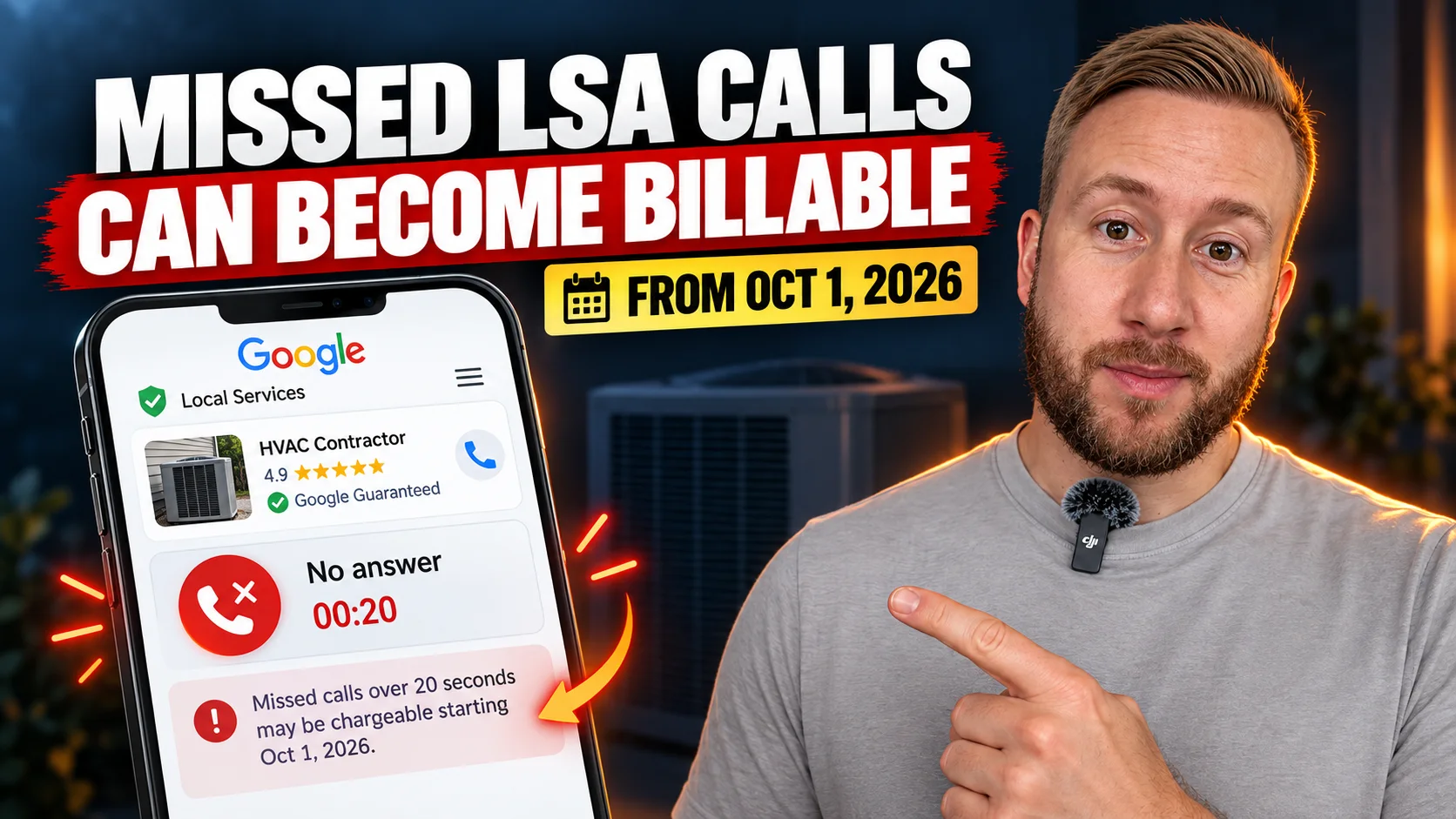
From 1 October 2026, a missed Local Services Ads call during your business hours becomes a billable lead if the caller stays on the line longer than 20 seconds.
Follow-up calls now count too. If the first call did not qualify, later calls between you and that homeowner will be charged if they meet Google's valid lead rules. You are charged once for follow-ups within 15 days of first contact.
There is one real escape: if your phone system makes callers press a key, the 20-second clock does not start until they press it, and there is no charge if they never do. Google says it is adding safeguards against robocalls and spam, but has not said how they work.
What Google Actually Said
Google's notice to advertisers says: “Missed calls during business hours will now be charged as valid leads if a user stays on the line for more than 20 seconds, with a few exceptions.”
On repeat contact: “If an initial call doesn't qualify as a charged lead, any follow-up calls between your business and the user that meet the valid lead criteria will be charged.”
Until now, an unanswered call cost you nothing. From 1 October, a ringing phone that nobody picks up can become a line on your invoice.
What It Costs You If You Ignore It
Local Services Ads in HVAC run about $51 a lead on average, and $45 to $80 in bigger metros, based on an analysis of $6.72 million of LSA spend across 888 home service contractors published in February 2026.
Miss five calls a week that ring for more than 20 seconds, at $51 each, and that is roughly $1,100 a month for calls nobody answered. In a metro at $80 a lead, it is closer to $1,700.
That is an example, not your number. Your number depends on your call volume and how often the phone rings out. You now need to know how often that happens.
Five Things To Do Before 1 October
Call Your Own Business Five Times
Try 8am, midday, 4:30pm, 7pm and Saturday morning. Time how long it rings before someone answers and note what happens when nobody does. If it rings past 20 seconds during hours you have listed as open, that is a future charge.
Make Your Listed Hours Match Reality
The charge only applies during the hours on your profile. If you have listed 8 to 6 but the office empties at 4:30, you have 90 minutes a day of billable silence. Set hours you actually cover and use the “more hours” fields for emergency availability.
Your hours can also affect where you rank because Google prioritizes businesses that are open when someone searches.
Decide On A Key-Press Menu Carefully
“Press 1 for service, press 2 for sales” stops the clock until the caller presses. It also puts a menu in front of a homeowner whose furnace has just died. Do not add a menu only to dodge a fee. Use it if you genuinely cannot cover the phone, and keep it to one level with service as option one.
Answer Inside 20 Seconds
That is three or four rings. Change the ring order so a mobile picks up when the office does not, put a second person on the rota at peak hours, or use an answering service for evenings and weekends.
Check Your Leads Weekly
Google lets you flag poor-quality leads in the feedback survey on each lead and credits some automatically. Automatic credits are available in the US and Canada only and not for every category. Review leads weekly while you still remember the call.
What I Would Actually Do
Do not treat this as a billing problem. It is a response-time problem that Google has now put a price on.
The contractors who lose here are the ones who have been quietly missing calls for years and never counted them. Every missed call was already a lost job. The only change is that now you also get the invoice.
Calls from your Google Business Profile and the Map Pack do not work this way. Nobody charges you per lead for those. That is why your whole lead flow should not sit on a meter, and why Local Service Ads management should work alongside SEO rather than replace it.